 http://www.vimeo.com/13550084 http://www.vimeo.com/13550084Here is a great little video from one of our volunteers, Helen Cogman, of Doris and Ting San playing in their enclosure at Matang Wildlife Centre where we run the Sarawak Orangutan Volunteer project. Here you get the chance to work alongside amazing animals just like these two as well as a huge range of other animals included clouded leopards, sun bears and binterong! Check out the website http://www.orangutanproject.com/ for more information. Labels: Borneo, borneo orangutan, great orangutan project, orangutan, sarawak, sunbears, volunteer with orangutans |
posted by Julie {:(|} @ 10:49 PM
2 comments
|


 Just a really quick update, latest photo of Kopral, the orangutan at Samboja Lestari who unfortunately lost his arms as explained in an earlier post. Here he is looking happy and healthy, great job everyone at Samboj Lestari for all their hard work and support of this true survivor!!! (and thanks Wiwik for the photo!) Labels: Borneo, borneo orangutan, East Kalimantan, kopral, samboja lestari, the great orangutan project |
posted by Julie {:(|} @ 12:58 AM
4 comments
|
 New orangutan programme soon to be aired! Orangutan rescue is due to start on Thursday 8th July at 9pm on Nat Geo Wild channel. Follow Michelle Yeoh on her journey meeting orangutans at Sepilok Rehabillitation Centre before trekking into the jungle at the Kinabatangan Wildlife Sanctuary. Follow in the footsteps of Michelle and take part on our Orangutan Pygmy Elephant Experience Labels: borneo orangutan, Kinabatangan, Michelle Yeoh, orangutan rescue, Sabah |
posted by Julie {:(|} @ 9:31 PM
0 comments
|
 Meet Kopral, an amazing survivor! He came into Samboja with severe burns to his arms and unfortunately had to have them both amputated. This was only back in January, and just look at him now (can you spot him high in the trees below?). Thanks to the dedicated care from the staff at the center he has come on in leaps and bounds. It just shows how strong their natural instinct is to be up in the trees, and just how tough this orangutan is. Where there is a will, there is definitely a way! Meet Kopral, an amazing survivor! He came into Samboja with severe burns to his arms and unfortunately had to have them both amputated. This was only back in January, and just look at him now (can you spot him high in the trees below?). Thanks to the dedicated care from the staff at the center he has come on in leaps and bounds. It just shows how strong their natural instinct is to be up in the trees, and just how tough this orangutan is. Where there is a will, there is definitely a way!.jpg) Labels: borneo orangutan, jungle training, Orangutans and Rehabilitation, samboja |
posted by Julie {:(|} @ 4:09 PM
1 comments
|
|
The youngest of Matang's new arrivals, Simanggang, is developing very well. Presently, he spends most of his days in the vet clinic, with Juan's wife, Sangang, as his primary carer. We are being careful to keep the number of humans around him down to a minimum to reduce the risk of him picking up any of our diseases, which could be fatal for him.
 Since arriving at Matang, Simanggang has required 24 hour care, which has meant the vet clinic has become a (less than comfortable!) home for some members of staff. He is, by all accounts, extremely healthy and has doubled in weight in the short time he has been here. His strength is quite remarkable for one so small - it is apparent that almost from birth, orangutan are superbly developed for a life of climbing and arboreal living.  Occasionally, this young orangutan has been taken to the trees to see how he may fare in the branches. This was partly inspired by watching Chiam and Ghanti's boys, who look to be similar in age. They are at a stage where the mums are giving them a small amount of independence to climb, around a cage or in Chiam's case, in the trees. There seems no better role model for guidance on baby orangutan than these two. Follow this link to see a short video of Simanggang's efforts in a tree. Click here for the video   In a few months, Simanggang will join Ali and Ting San on their daily excursions to the jungle for more routinised training. For now though, until he is older, he remains at the vet clinic to continue to gain weight and strength.  Labels: baby orangutan, borneo orangutan, matang, Orangutans and Rehabilitation |
posted by Julie {:(|} @ 9:26 PM
0 comments
|
|
Chiam has long been a favourite of volunteers and keepers alike at Matang. She is a highly intelligent orangutan, and has fascinated many on onlooker with her swift and accurate construction of tools out of mere scraps of rope and left over food items. Chiam's presence at the centre was bitter sweet - it was a joy to observe her and a privilege to get to know her, but she has long been ready for life in the jungle.
Part of the centre's captive breeding program; Chiam gave birth to George's son in February 09. Her infant developed quickly, and Chiam's stress-free approach to motherhood quickly fostered an ambitious and independent son. At just two months of age he was already exploring his cage in absense of his mother and flexing his young climbing muscles on the bars.
In May 09, the decision was made to release Chiam. Her infant had developed extremely well and it was more than clear that Chiam is a competent mother. At the begining of June, Chiam was released into Kubah. Though it had been hoped to release Chiam, George and Ghanti together, it made good sense to release Chiam earlier. With Mamu being in the rainforest, it is a good step to have a competent adult join her in the environment, so should Mamu have any difficulty in food location or nest building, Chiam can watch over her and offer assistance. Though Ghanti herself would not struggle in the jungle, she is being kept at Matang for the near future so that staff here may keep a closer eye on her infant and ensure its healthy development. He is currently developing well, but Ghanti does not have the carefree confidence in motherhood that Chiam displayed, not surprising since for Chiam, she had done it all before.
As a dominant male, George would not be safe to be released too close to the centre. Therefore, we will still build a release site for him futher into Kubah, which is the task of July 09 volunteers. Over the next few months, keepers will slowly move Chiam through the jungle to this new site, so when it is time to release George and Ghanti, Chiam will be centred on this area also. This will then become the primary feeding area for the 3 adult orangutan, plus the two babies. Our immense gratitude goes out to all volunteers, past, present and future. For many of those past, you worked tirelessly at the centre and dedicated your money to it for the future when the orangutan you got to know so well would be in a position to be released. Many of you never saw an orangutan in the jungle at Matang, and indeed it has taken many years for us to begin to realise the release plans. Whether you were building a feeding platform for the orangutan, or building a deer enclosure at the centre, it is all of these efforts combined that have brought Matang up to a standard where release of orangutan is not just feasible, but is now happening. We cannot thank you enough and hope that when we collect the first few photos of Chiam in the jungle with her baby you will all consider it your success as well Labels: borneo orangutan, chiam, jungle, kubah national park, mamu, matang, rainforest |
posted by Julie {:(|} @ 11:18 PM
2 comments
|


|
Mamu, the daughter of Chiam and Aman, was born at the centre in 2004. She spent her first couple of years in the trees with her mum, but it became clear that Chiam was struggling to provide for both herself and her infant while roaming the forest, so mother and child were brought back to the centre, separated, and provided with lots of nutrition. Since that point, Chiam has given birth to a second baby and Mamu has been continuing jungle training under the careful supervision of our orangutan rehabilitation officers, Hilary Kidding and Eddie Indriss.
She began with day trips into the jungle, where she was quickly mixed with Ting San, another orangutan of similar age who was far less competent in the trees. Mamu proved good inspiration for Ting San, who has come on leaps and bounds in her jungle training. These two orangutan often spent nights out in the jungle too, though Ting San was far less keen on this experience than Mamu. Occasionally, where simple day trips were planned, Mamu would decide to remain out in the jungle over night, meaning her keepers regularly spent unscheduled nights in the forest close to her. 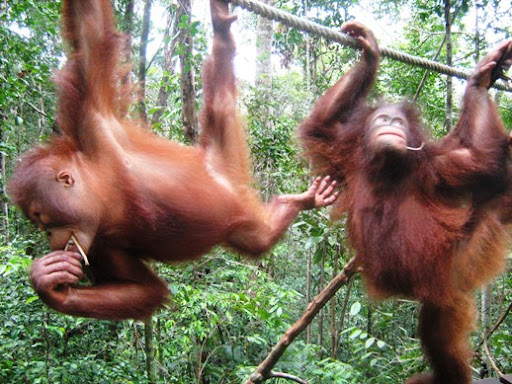 Since November 08, Mamu and Ting San have been spending one week a month at the Piers Mott ranger station, built by volunteers in Kubah National Park, about a 2km trek from the centre. Keepers have been able to stay in (relative) comfort in this building, while the orangutan explore the surrounding jungle both day and night, being fed at the neighboring feeding platform built by volunteers in October 08. This year, Mamu has been showing increasing reluctance to return to the centre at the end of her periods of training. Mamu has certainly been ready for release for a number of months - she was being held back to fulfill a role of teacher for both Ting San and Doris, who is widely lacking in knowledge of jungle survival. However, Mamu obviously tired of this role, and after one week at the ranger station in April, decided that she would be happier to remain in the jungle. This site had been prepared for exactly this purpose, so it seemed as good a time as any to leave her out.  Both keepers and volunteers have been making daily excursions to the feeding platform by the ranger station to ensure Mamu will always be able to feed, should she not be able to find enough food in the trees. She is certainly missed at the centre, by none more than Doris who had formed a very close relationship with her. However for us, though it is strange not to see her on a daily basis, the knowledge that she is brachiating through the rainforest by day, foraging for natural foods and nesting in the treetops at dusk, more than compensates for her absence. Indeed, it is exactly what we have been working so hard to achieve, and the release of one makes us all the more determined to give her some company in Kubah. 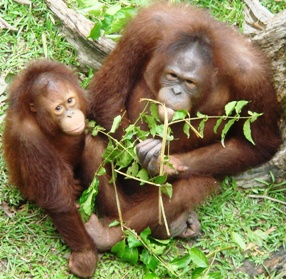 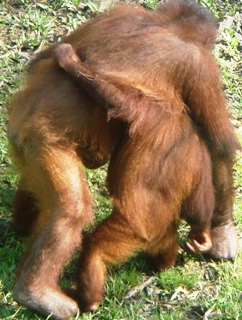 Labels: aman, borneo orangutan, great orangutan project, kubah national park, matang, orangutan, orangutan mother, orangutan release, Orangutans and Rehabilitation |
posted by Julie {:(|} @ 11:34 PM
4 comments
|
 We are pleased to bring you another image of Chiam's young boy. Mother and baby are doing extremely well - Chiam behaves completely naturally, almost as if there is no newborn clinging to her side.  The picture of the sack you see is in fact Ghanti and her newborn - Ghanti chose to remain in her sack for the majority of her first week as a new mum, which is why we have been slow in introducing her baby boy to the world.  Though we have now managed to photograph her up and about and feeding her newborn. Ghanti has been particularly lethargic following the birth, typical of any first time mum. Her and the baby are in really good health and her energy levels now seem to be on the increase. We will of course add more photo's as soon as they are available Labels: borneo orangutan, matang, orangutan baby |
posted by Julie {:(|} @ 10:04 PM
0 comments
|
|
We interviewed Leo Biddle, the Borneo manager at WOX’s Great Orangutan Project in Sarawak and how the new orangutan moms and tots are getting on.
 So Leo you must be very proud, are the babies healthy? 48 hours from birth there are no complications so far. It is everything we hoped for. Babies are not separate from their moms and remain clung on to their mothers 24/7 as you would expect, but babies support their own weight. They don’t cry, they do make some noises. Also did you know that both baby orangutan came out blonde. They will go deeper orange as they get older, but for now we have blonde baby orangutans! How are the orangutan mothers coping with motherhood?  Gante (one of the mother orangutans) and baby nearly the entire time have been in guni sacks. She carries the sacks around with her constantly, possibly using them to keep warm. Gante is not as social as Chiam (the other lucky mom) so stays hidden in sacks. They are both well and healthy. They are not eating much but we did expect this. We have been given them a wide selection of foods to choose from - an open buffet for our precious moms. (Chiam is also mother to Mamu who is also at our centre and going to school for jungle training). What is the reaction if any from other orangutans? Doris (our teenage orangutan) sees the team and keepers going in and out of the maternity enclosures and gets very jealous almost saying “hey there I want some attention!” (very typical of Doris). Orangutans from the start were very aware that babies were coming. You could tell by their body language. On the day of birth they could smell the afterbirth. Because we require more space for the moms we have moved the orangutans around. We do what we can in limited space. So other orangutans are getting a bit frustrated. George, the father of the two baby boys, is highly protective. Other than me and members of the WOX team, when people he doesn’t know pass by, he starts barking and getting angry. “Back off my babies boys!”. I myself growl at people wanting to see babies also…my own paternal instincts kicking in. How do you create a post-natal environment for the benefit of the orangutan moms and orangutan babies? We increased warmth to the enclosures with more guni sacks, increase leaves, blankets so the orangutan moms can build nests. The idea is by keeping moms warm we keep orangutan babies warm. We keep quiet. We have increased food supply and a good selection of foods for our moms. They seem to take to the leafy greens so we have more of that. Gante and Chiam have a choice of night dens and enclosures and can move freely between them. We do what we can to keep them happy. And we constantly monitor them. The moms seem very responsible. You personally have spent so much time with your “orangutan ladies”, how do you feel? I don’t know if I should say this, but I’m really paranoid. Infant mortality rates are high in any centre. It’s a great concern in the world of orangutan conservation. New borns are weak and susceptible to diseases. So we are going all out to make this work. You have my all. ------------------------------------------------------------------------------------ Thanks to Leo, Tasha, Alvin, Mazrul, Hilary and the rest of the WOX team and SFC team working round the clock to keep our new moms and babies happy and healthy. It’s challenging times in Borneo but a great privilege to be part of the miracle of a synchronised birth of two baby orangutans on the same day at the same centre. So there you have it orangutan people, so now get off the blog and get on a plane to Borneo. Be part of the experience and join us on the Sarawak Orangutan Volunteer Programme during the next months or take advantage of our Orangutan Baby Special – 2 week volunteer programmes for May and June 2008. It’s our way of connecting you with baby orangutans. This moment is extremely rare. To be in the same vicinity of baby orangutans is magic. Packed with emotions, these next few months will require people with passion and belief that orangutans will make it through. We have increased the orangutan population by a tiny fraction, but it’s on the way up and you, the volunteer community help us make this happen. On the Orangutan Baby Special – you will volunteer at Matang Wildlife Centre in Sarawak Malaysia Borneo and you will also be working on improving the lives of resident animals such as sunbears, crocodiles, etc and witness the challenges our conservation team face keeping new born baby orangutans healthy. PLEASE NOTE: THERE WILL BE NO TOUCHING OR CARRYING OF ANY ORANGUTANS. PLEASE RESPECT THE MOTHERS FEELINGS AND THE ALPHA MALE FATHER, GEORGE WHO, LIKE ANY PROUD DAD, WILL BE VERY IRRATE IF YOU TOUCH HIS BABY BOYS. WE ASK FOR PASSION WITH RESPONSIBILITY. THANK YOU. Labels: baby, baby rehabilitation, borneo orangutan, great orangutan project, matang wildlife centre, orang utan, orang-utan, orangutan, orangutan volunteer, volunteer with orangutans |
posted by Guillaume @ 7:10 PM
2 comments
|
 We are ecstatic to report that today, both Chiam and Ghanti, adult orangutan females, gave birth to baby boys. Chiam's baby was noticed first as volunteers were about to start cleaning her night den in the morning, and Ghanti gave birth that lunch time. Both mothers and babies are doing really well and appear to have taken naturally to motherhood, which we expected of Chiam, a second-time mother, and is great to see from Ghanti, who has given birth for the first time. It is quite incredible that both females gave birth on the same day - at least is will be easy to remember their birthday! Labels: baby rehabilitation, borneo orangutan, matang wildlife centre, orangutan, Orangutans and Rehabilitation |
posted by Guillaume @ 4:57 PM
3 comments
|
 When The Great Orangutan Project first started our orangutan volunteer programme with Sarawak Forestry at Matang Wildlife Centre in 2005, many experts were convinced that Doris, a young adult female of 6 years of age at the time, would spend the remainder of her days in captivity. The logic was that she had been too close to humans, that she would always return to the safety and comfort of the centre. Outwardly, she was also terrified of the jungle which led one expert to declare she had vertigo! However, for us the choice was simple. There is little conservation outcome to be gained by leaving a happy Doris in an enclosure to wave at passing tourists – so, if we can manage it safely for her, she would go back out. 3 years on, and a lot of time-in-the-jungle afterwards, we and the staff at Matang Wildlife Centre are convinced that this wonderful orangutan has a future in the trees. Doris continues to make her forays into the jungle and her behaviour there is improving markedly; however there is still a long way to go. Unlike other orangutans, Doris does not want a jungle existence. This has been witnessed numerous times in other orangutans at other rehabilitation centres and it can be overcome.  Doris with young Mamu, a 3 year old female. Pairing orangutans together is a successful strategy which increases their confidence to stay out in the jungle and allows them to share survival techniques. Previously the issue had been that Doris would panic, turn and make a run for the centre, often at the fringe of the jungle boundary. The solution has been to physically carry her far enough into the jungle that it is too late to turn back. Given the opportunity, she will face up to any challenge if she is with someone familiar to her. At first we needed to only carry her 100m or so and she would be happy after that to follow on foot; but as time wore on, and she had grown more familiar with the territory, she was simply walk back to the centre. Occasionally she would go back into her night den and shut the door. Cunning was needed. Doris is almost fully grown and extremely strong and therefore cannot be allowed to wander around the centre unchecked. At the start of the month we were finding it necessary to carry Doris 2-3km into the jungle before being able to put her down, not easy with a 47kg orangutan. Until about midway through we decided to use the volunteers as bait for her. Sending them up ahead with food was generally enough to motivate Doris into exploring the jungle owing to the novelty of the situation. This will discontinue as we need Doris to get over humans but at the moment it seems to work wonderfully in getting her to explore her natural habitat. Doris is doing very well. She is nowhere near as scared as she initially was. When out she will eventually wander off and even climb a tree. All of the other orangutans are happy and healthy and the centre is looking at how we can get these adults out into the trees as well as the adolescents. Together they will learn the skills of the jungle, and eventually live wild. Orangutans are far from extinct in the rainforests of Sarawakian Borneo.  Labels: borneo orangutan, great orangutan project, orang utan, orang-utan, orangutan, rehabilitation |
posted by Guillaume @ 4:20 AM
0 comments
|
|
Our two young orangutan, Ting San and Mamu, continued to go out most days as a pair for their jungle training at our nearby feeding platforms with two of our rehabilitation officers Hillary and Jugah. Mamu has practically doubled in bodyweight since our orangutan expert recommended separating her from her companions in her enclosure and has improved tremendously.
Though still young, Mamu continually impresses us all with her degree of jungle expertise, and serious rehab has proven to be the best thing to ever happen to Ting San.  Unless the weather is particularly bad the two of them will generally stay out all day in the surrounding forest generally coming back in around 4 or 5 in the early evening; Mamu’s affinity for the tree tops is successfully rubbing off on Ting San and she now spends less and less time seeking out human contact at ground level and emulating Mamu’s superior climbing technique in the canopy. Things are extremely positive for the both of them. Labels: Borneo, borneo orangutan, borneo orangutans, great orangutan project, orang utan, orangutan volunteer, Orangutans and Rehabilitation, volunteer with orangutans |
posted by Guillaume @ 1:19 AM
0 comments
|

