|
Matang has recently become resident to an adult male Bornean gibbon, named Kiko. A long standing resident at the centre, Teresa, is a female Bornean gibbon, and she has been housed alone for a number of years due to lack of a suitable mate - only a handful of gibbons have arrived at the centre over the years, all female, and female gibbons do not get on well with each other.
After a round of blood tests to check the health of both individuals, Kiko has been moved next door to Teresa, with the bars of a cage separating them to see if they show any affection for each other. The picture below shows the arrangement, though Teresa refuses to pose for our cameras and is hidden at the back of the cage. Kiko is on the right.  They have been living this way for a week now, and to be honest Teresa is not looking very interested. However, it is early days and she has been a bachelorette for a while so we're not writing off the possibility of a partnership just yet. Just next door, the new gibbon enclosure has been completed and the two smallest gibbons have moved in. Below is a picture of them, but at the time they were hurling themselves around and bouncing off the ropes, so it was hard to catch an image.  This cage is split into three sections, and at the moment these small gibbons have a cage each. They were initially introduced to the same space after residing next to each other in smaller cages for many weeks and showing positive signs of friendship. However, the larger of the two, the male, was so excited to be in the huge space that he frightened the small female and left her a quivering wreck in the corner on the floor! So they are split for now so she has a chance to get used to the new house in relative peace, but there should be no problem with introducing them to the same space in the near future and hopefully a successful partnership will form. I will attempt to capture some of their joy and acrobatics in a short video and upload it to our facebook group shortly. Labels: Gibbon, great orangutan project, matang wildlife centre, the great projects |
posted by Anonymous @ 7:58 PM
25 comments
|


 Unfortunately, the sun bear born at Matang at the beginning of February this year did not make it. It reached around 4 weeks old, at which point the behaviour of the mother changed quite dramatically. For the previous weeks, she had remained in the outdoor enclosure, occasionally coming to the night den area for food but always returning quickly to the den she had created in the enclosure. During the fourth week, her behaviour reverted back to normal – she was spending the nights back in the night den (the door was left open for her) and the day times foraging in the enclosure for food. She showed little interest in the den she had constructed. On the third day of this behaviour, staff and volunteers thoroughly searched the outdoor enclosure for any sign of the cub and could find none. Though disappointing, it is still hugely encouraging that these bears are displaying successful reproductive behaviour. This female has now had 2 attempts at motherhood, and with just these 2 she already showed a massive improvement in natural behaviour displayed. On the first occasion she didn’t seem to notice that she had given birth, but on the second attempt she built a fantastic den and completely isolated herself from the other bears, which is much more reminiscent of a bear’s natural behaviour. Bears do seems to require practise to get motherhood right in captivity, and this female certainly seems to be progressing in the right directing. Hopefully her future attempts will see increasing success until there is a healthy, surviving cub here at Matang. Labels: great orangutan project, matang wildlife centre, sun bear |
posted by Anonymous @ 11:49 AM
2 comments
|
|
On Sunday 6th February, a sun bear cub was born at Matang Wildlife Centre. On being released to the outdoor enclosure that morning, mother Gaby made a hasty run for the roots of the large, white tree in the hill enclosure and started digging out a den area immediately. She then gave birth sometime during that day. Keeper Eddie was alerted to extraordinary happenings when he tried to bring this set of bears in that afternoon, noting one was missing. On exploring the outdoor area, he finally located her deep in the roots of the tree, preciously guarding a small, naked, squeaking figure.
 This is the second time this bear has given birth that we know of, though her first attempt two years ago was still born. We suspect Gummy to be the proud father, as Gaby and Gummy frequently share a night den each evening. Though Gummy is incredibly old and very frail-looking, he is clearly still full of life!  The pictures displayed here were taken by keeper Eddie Inddris, who was incredibly daring to say the least to approach mother sun bear guarding her cub in her den. The pictures of the cub on its own were taken when Gaby returned to the night den to collect food. She is currently being given the whole outdoor enclosure to herself to enable the cub to have optimal survival chances. We also do not want Gaby to be unnecessarily stressed by the presence of other bears, particularly given the aggressive nature of both the males, Gummy and Wong, in this enclosure.  From the photo above you can see that it is currently about the size of a banana. In a few more weeks this tiny creature will be more recognisable as a bear cub, and we look forward to sharing more images with you all and it grows and develops. Labels: bear cub, great orangutan project, matang wildlife centre, sun bear |
posted by Anonymous @ 10:10 PM
3 comments
|
|
A slow loris, recently surrendered to Matang Wildlife Centre, was successfully released into the surrounding Kubah National Park. The animal was in good health on arrival to the centre and it was deemed in its best interest to return it to the wild.
 The slow loris is nocturnal by nature, and this individual was certainly confused by so much action taking place for it during daylight hours. It sat through a 40minute walk through the forest in a carry case to a release site a couple of kilometres away from the centre and human civilisation. On reaching this destination though, it was not too eager to escape its cage and make for the trees.  Most people assume that when an animal is presented with its natural environment, it will quickly run towards its home and freedom. Sadly, this is rarely the case as animals become used to captivity very rapidly and are often reluctant to leave this existence behind. After some lengthy consideration though, the slow loris did indeed step out of the box and, despite its name, make a hasty line for the forest. We hope to catch images of it on the camera traps recently donated to the centre.  Labels: great orangutan project, matang, orangutan, slow loris, the great projects |
posted by Anonymous @ 4:35 PM
4 comments
|
  Recognition for Great Orangutan Project at the Virgin Holidays Responsible Tourism Awards 2010 Great Orangutan Project run by Way Out Experiences, has been highly commended in the Best volunteering organisation category at this year’s Virgin Holidays Responsible Tourism Awards. The Great Orangutan Project is part of a family of animal protection projects under newly launched The Great Projects (www.thegreatprojects.com) The Judges said “Tough times in the tourism industry can often lead to integrity being the first value to take a cut. Not so with Great Orangutan Project – who have continued to provide wildlife experiences without allowing volunteers physical contact with the orangutans. The now ABTA-listed organisation demonstrates good practice in volunteering with increasing commitments to accountability and transparency.” At a ceremony hosted at World Travel Market (WTM), Docklands, London, on Wednesday 10th November, the Awards were handed out by Justin Francis, managing director of responsibletravel.com, organisers and founders of the Awards, and Amanda Wills, managing director of Virgin Holidays, headline sponsor of the Awards. The Awards are the most prestigious and competitive of their kind in the world and are a collaboration between online travel directory responsibletravel.com; UK media partners Metro Newspaper and Geographical Magazine and World Travel Market who host the ceremony. The central tenet of the Awards is that all types of tourism - from niche to mainstream - can and should be operated in a way that respects and benefits destinations and local people. Afzaal Mauthoor, co-founder of Way Out Experiences and Managing Director The Great Projects – Way Out Experiences Ltd receives award from Justin Francis above and says at the awards: “The Great Projects like the Great Orangutan Project is an example of animal protection tourism where your travel can help save endangered animals abroad. It was a bold concept started 6 years ago. It’s now firmly rooted in the responsible travel movement after winning the award two years in a row. Its travel experiences like ours that add the responsible and compassionate side to tourism today - to protect vulnerable animals in vulnerable habitats for our future generations.” Launched in 2004, the Awards are run in association with partners World Travel Market, Metro Newspaper and Geographical Magazine industry. Visit The Great Projects website on www.thegreatprojects.com to find out and the award winning project The Great Orangutan Project www.orangutanproject.com Or call us on 0845 3713070 (within UK), or +44 1582 469950 (outside UK) Email: volunteer@w-o-x.com Labels: Best Volunteer Organisation, great orangutan project, Justin Francis, the great projects, Virgin Holidays Responsible Tourism Awards 2010 |
posted by Julie {:(|} @ 11:18 PM
0 comments
|
|
Now, the arrival of kittens at the centre is not actually a rare event, as many past volunteers will be aware. However this particular kitten is, no offense to regular cats, a bit more special than the average.
 It's a very young leopard cat, estimated to be around 3-4 weeks of age. He needs to be syringe-fed, which he was not very keen on originally but is now a bit more accepting of the strange instrument. He has recently started trying small pieces of meat, and shows a great appetite for it, guarding the food with an aggression that is a bit hard to take seriously, considering his size.  These cats are offically listed by IUCN as Least Concern, though precious little academic research exists with regards to them, particularly the Bornean subspecies. They are solitary, as with most wild cats, though we hope with a careful integration process this kitten will be able to join the existing pair at Matang in time. With thanks to Kuno and Lauren Schiffermuller for the images, volunteers in September 10. Labels: great orangutan project, leopard cat, orangutan volunteer, sarawak orangutan volunteer |
posted by Julie {:(|} @ 5:08 PM
1 comments
|
|
The sun bear known as ‘Baby bear’ to many volunteers has recently moved house out of the quarantine area and into the larger sun bear enclosure housing the other ‘quarantine bears’. Though she is still significantly smaller than these other adults, it was deemed time to begin the familiarisation process. She currently has one of the night dens to herself, and we are giving her and the other bears time to get used to each other through the safety of the cage. She was pretty scared for the first couple of days, and her defensive shouting at the other bears provoked some aggressive responses, but she soon calmed down and the others now seem at peace with their new neighbour. It may still be some time before she is let out with the others though.
 Though she is still spending the majority of her time in a cage, every now and then we are keeping the four adults in and letting her enjoy the outdoor enclosure by herself. Letting her out for the first time was incredibly exciting, and she seemed incredibly pleased by the experience.  The picture below shows her following and enjoying a honey trail leading out of the night den. Baby bear has always showed great natural behaviour, even though she has been confined to a small, unnatural area. She did not disappoint in the outdoor space, foraging for most of the day, digging vigorously at the ground and climbing trees with ease.  Her next stage is obviously full integration with the existing group, and until then she will continue to enjoy days exploring the outdoor space. We also have a video of her first outdoor excursion, which will be posted soon. Labels: great orangutan project, matang wildlife centre, orangutan volunteer, sun bear |
posted by Julie {:(|} @ 2:17 PM
0 comments
|
|
Boboy, the long tail macaque with a big personality, was released from Matang Wildlife Centre last year. He was chosen as a monkey to test a possible release site for all long tail macaques because he was not coping well with the stress of captivity. He was released onto an island in Kuching Wetlands Park, a site away from human habitation which is key for macaque release.
 Though we visited the site regularly, we were not lucky enough to spot Boboy for a long time. However, recently has was seen enjoying the natural habitat on the island, and looking in excellent health. This is incredibly good news, both for the welfare of this one individual, and for the potential of the area to accept more of his species.  Boboy was a favourite character of many volunteers that met him, and to those with fond memories of him, please enjoy the images of him enjoying his new lease of life.  Labels: great orangutan project, Long tail macaque, matang wildlife centre, orangutan volunteer, sarawak orangutan volunteer |
posted by Julie {:(|} @ 1:34 PM
1 comments
|
 http://www.vimeo.com/13550084 http://www.vimeo.com/13550084Here is a great little video from one of our volunteers, Helen Cogman, of Doris and Ting San playing in their enclosure at Matang Wildlife Centre where we run the Sarawak Orangutan Volunteer project. Here you get the chance to work alongside amazing animals just like these two as well as a huge range of other animals included clouded leopards, sun bears and binterong! Check out the website http://www.orangutanproject.com/ for more information. Labels: Borneo, borneo orangutan, great orangutan project, orangutan, sarawak, sunbears, volunteer with orangutans |
posted by Julie {:(|} @ 10:49 PM
2 comments
|
|
During the first three weeks that Chiam was out in the national park, keepers only saw her once as she came to investigate Ting San's rehabilitation training. Though they continued to call for her and place food at feeding platforms twice a day, it seems Chiam was enjoying herself too much to be concerned with coming back when called for easy food. Indeed, during her first 4 hours out, Chiam built 4 nests, which is certainly in excess of what's required! Orangutan will always build a nest for sleeping, and will commonly make one day nest to take a rest from foraging, but four in one afternoon is certainly not seen. It seemed Chiam was simply feeling the joy of the trees once again. However, recently Chiam returned to the feeding platform recently built on the trail to the ranger station.
 She came down in response to keepers calling for her, as they have been doing each day twice daily. The aim of this was to let Chiam know that there would always be someone in the jungle to feed her, should she require extra food. This has obviously worked, Chiam had known where the keepers were going to be at what time and responded to their call.  Both her and the baby appear to be in great health and obviously enjoying their time in the trees. It is wonderful to know how much Chiam's son will now be learning about his natural environment, and we can only imagine how fast he will pick up natural survival skills such as nest building and foraging with Chiam as his teacher.  We hope that this will be the first of many occasions that Chiam returns to our feeding platforms for food.  Labels: feeding platform, great orangutan project, matang wildlife centre, orangutan, orangutan baby, orangutan mother, orangutan release |
posted by Julie {:(|} @ 11:01 PM
0 comments
|
|
Mamu, the daughter of Chiam and Aman, was born at the centre in 2004. She spent her first couple of years in the trees with her mum, but it became clear that Chiam was struggling to provide for both herself and her infant while roaming the forest, so mother and child were brought back to the centre, separated, and provided with lots of nutrition. Since that point, Chiam has given birth to a second baby and Mamu has been continuing jungle training under the careful supervision of our orangutan rehabilitation officers, Hilary Kidding and Eddie Indriss.
She began with day trips into the jungle, where she was quickly mixed with Ting San, another orangutan of similar age who was far less competent in the trees. Mamu proved good inspiration for Ting San, who has come on leaps and bounds in her jungle training. These two orangutan often spent nights out in the jungle too, though Ting San was far less keen on this experience than Mamu. Occasionally, where simple day trips were planned, Mamu would decide to remain out in the jungle over night, meaning her keepers regularly spent unscheduled nights in the forest close to her. 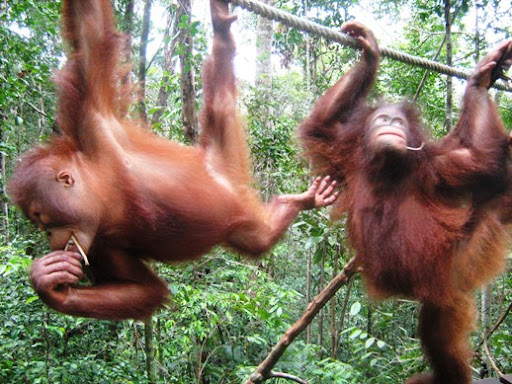 Since November 08, Mamu and Ting San have been spending one week a month at the Piers Mott ranger station, built by volunteers in Kubah National Park, about a 2km trek from the centre. Keepers have been able to stay in (relative) comfort in this building, while the orangutan explore the surrounding jungle both day and night, being fed at the neighboring feeding platform built by volunteers in October 08. This year, Mamu has been showing increasing reluctance to return to the centre at the end of her periods of training. Mamu has certainly been ready for release for a number of months - she was being held back to fulfill a role of teacher for both Ting San and Doris, who is widely lacking in knowledge of jungle survival. However, Mamu obviously tired of this role, and after one week at the ranger station in April, decided that she would be happier to remain in the jungle. This site had been prepared for exactly this purpose, so it seemed as good a time as any to leave her out.  Both keepers and volunteers have been making daily excursions to the feeding platform by the ranger station to ensure Mamu will always be able to feed, should she not be able to find enough food in the trees. She is certainly missed at the centre, by none more than Doris who had formed a very close relationship with her. However for us, though it is strange not to see her on a daily basis, the knowledge that she is brachiating through the rainforest by day, foraging for natural foods and nesting in the treetops at dusk, more than compensates for her absence. Indeed, it is exactly what we have been working so hard to achieve, and the release of one makes us all the more determined to give her some company in Kubah. 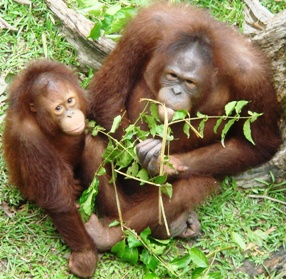 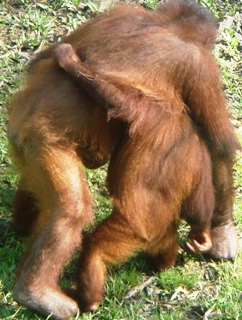 Labels: aman, borneo orangutan, great orangutan project, kubah national park, matang, orangutan, orangutan mother, orangutan release, Orangutans and Rehabilitation |
posted by Julie {:(|} @ 11:34 PM
4 comments
|
 Chiam and Ghanti Born on Feb 3rd 09, Chiam and Ghanti’s boys are now 3 and a half months old. It is truly fascinating to watch the differences in the approach to motherhood between the two apes. Ghanti is a first time mother, and is evidently cautious, wary and highly attentive to her baby. Whenever he makes the faintest of squeaks, she gives him her full attention, checks over every angle of him, runs her lips over his body as comfort as well as investigation, and keeps the baby close to her. She remains more reserved, and though has been revisiting the outside world, will mostly remain on high in nest or hammock, away from the distractions of staff and tourists and devoting attention to her baby.  Chiam is a different story. She is a second time mother, and perfectly aware that parenting is nothing to stress over. When watching her behaviour, you would not know she had a baby clinging to her unless you caught sight of him. When Chiam’s baby squeaks or begins to cry, she moves it further out of ear shot, generally onto her back. As a result, Chiam’s baby is showing more independence than Ghanti’s. Our May volunteers saw Chiam’s boy climbing to the top of the night dens, solo – with Chiam forming a carefully placed safety net below his every move. She is certainly also a devoted mother, as all female orang-utan are, and volunteers also saw her create something of a mobile with branches and leaves in her enclosure and hang it above her baby’s head, moving it to and fro with her baby thoroughly entertained below. Separated for the first couple of months to allow the females to settle stress-free into motherhood, Chiam and Ghanti have recently been reintroduced to each other. They have shown great interest in each other’s babies, and there has definitely been a sense of showing off each son to the other mum. They each seem extremely pleased and proud, with both themselves and each other. Recently, Chiam was seen encouraging her baby to climb - she was placing his hands on a rope above her head and supporting his weight, lifting him up and assisting his holds. A few minutes later, Ghanti, who had obviously been watching this lesson closely, followed suit. She took up Chiam’s position and was placing her baby’s hands on the rope. Her baby was much more reluctant to explore the area away from his mother’s body, but this example of learning and imitation through observation was truly fascinating.  Labels: great orangutan project, matang wildlife centre, orang-utan, orangutan, orangutan baby |
posted by Julie {:(|} @ 5:29 PM
0 comments
|
|
We interviewed Leo Biddle, the Borneo manager at WOX’s Great Orangutan Project in Sarawak and how the new orangutan moms and tots are getting on.
 So Leo you must be very proud, are the babies healthy? 48 hours from birth there are no complications so far. It is everything we hoped for. Babies are not separate from their moms and remain clung on to their mothers 24/7 as you would expect, but babies support their own weight. They don’t cry, they do make some noises. Also did you know that both baby orangutan came out blonde. They will go deeper orange as they get older, but for now we have blonde baby orangutans! How are the orangutan mothers coping with motherhood?  Gante (one of the mother orangutans) and baby nearly the entire time have been in guni sacks. She carries the sacks around with her constantly, possibly using them to keep warm. Gante is not as social as Chiam (the other lucky mom) so stays hidden in sacks. They are both well and healthy. They are not eating much but we did expect this. We have been given them a wide selection of foods to choose from - an open buffet for our precious moms. (Chiam is also mother to Mamu who is also at our centre and going to school for jungle training). What is the reaction if any from other orangutans? Doris (our teenage orangutan) sees the team and keepers going in and out of the maternity enclosures and gets very jealous almost saying “hey there I want some attention!” (very typical of Doris). Orangutans from the start were very aware that babies were coming. You could tell by their body language. On the day of birth they could smell the afterbirth. Because we require more space for the moms we have moved the orangutans around. We do what we can in limited space. So other orangutans are getting a bit frustrated. George, the father of the two baby boys, is highly protective. Other than me and members of the WOX team, when people he doesn’t know pass by, he starts barking and getting angry. “Back off my babies boys!”. I myself growl at people wanting to see babies also…my own paternal instincts kicking in. How do you create a post-natal environment for the benefit of the orangutan moms and orangutan babies? We increased warmth to the enclosures with more guni sacks, increase leaves, blankets so the orangutan moms can build nests. The idea is by keeping moms warm we keep orangutan babies warm. We keep quiet. We have increased food supply and a good selection of foods for our moms. They seem to take to the leafy greens so we have more of that. Gante and Chiam have a choice of night dens and enclosures and can move freely between them. We do what we can to keep them happy. And we constantly monitor them. The moms seem very responsible. You personally have spent so much time with your “orangutan ladies”, how do you feel? I don’t know if I should say this, but I’m really paranoid. Infant mortality rates are high in any centre. It’s a great concern in the world of orangutan conservation. New borns are weak and susceptible to diseases. So we are going all out to make this work. You have my all. ------------------------------------------------------------------------------------ Thanks to Leo, Tasha, Alvin, Mazrul, Hilary and the rest of the WOX team and SFC team working round the clock to keep our new moms and babies happy and healthy. It’s challenging times in Borneo but a great privilege to be part of the miracle of a synchronised birth of two baby orangutans on the same day at the same centre. So there you have it orangutan people, so now get off the blog and get on a plane to Borneo. Be part of the experience and join us on the Sarawak Orangutan Volunteer Programme during the next months or take advantage of our Orangutan Baby Special – 2 week volunteer programmes for May and June 2008. It’s our way of connecting you with baby orangutans. This moment is extremely rare. To be in the same vicinity of baby orangutans is magic. Packed with emotions, these next few months will require people with passion and belief that orangutans will make it through. We have increased the orangutan population by a tiny fraction, but it’s on the way up and you, the volunteer community help us make this happen. On the Orangutan Baby Special – you will volunteer at Matang Wildlife Centre in Sarawak Malaysia Borneo and you will also be working on improving the lives of resident animals such as sunbears, crocodiles, etc and witness the challenges our conservation team face keeping new born baby orangutans healthy. PLEASE NOTE: THERE WILL BE NO TOUCHING OR CARRYING OF ANY ORANGUTANS. PLEASE RESPECT THE MOTHERS FEELINGS AND THE ALPHA MALE FATHER, GEORGE WHO, LIKE ANY PROUD DAD, WILL BE VERY IRRATE IF YOU TOUCH HIS BABY BOYS. WE ASK FOR PASSION WITH RESPONSIBILITY. THANK YOU. Labels: baby, baby rehabilitation, borneo orangutan, great orangutan project, matang wildlife centre, orang utan, orang-utan, orangutan, orangutan volunteer, volunteer with orangutans |
posted by Guillaume @ 7:10 PM
2 comments
|
 When The Great Orangutan Project first started our orangutan volunteer programme with Sarawak Forestry at Matang Wildlife Centre in 2005, many experts were convinced that Doris, a young adult female of 6 years of age at the time, would spend the remainder of her days in captivity. The logic was that she had been too close to humans, that she would always return to the safety and comfort of the centre. Outwardly, she was also terrified of the jungle which led one expert to declare she had vertigo! However, for us the choice was simple. There is little conservation outcome to be gained by leaving a happy Doris in an enclosure to wave at passing tourists – so, if we can manage it safely for her, she would go back out. 3 years on, and a lot of time-in-the-jungle afterwards, we and the staff at Matang Wildlife Centre are convinced that this wonderful orangutan has a future in the trees. Doris continues to make her forays into the jungle and her behaviour there is improving markedly; however there is still a long way to go. Unlike other orangutans, Doris does not want a jungle existence. This has been witnessed numerous times in other orangutans at other rehabilitation centres and it can be overcome.  Doris with young Mamu, a 3 year old female. Pairing orangutans together is a successful strategy which increases their confidence to stay out in the jungle and allows them to share survival techniques. Previously the issue had been that Doris would panic, turn and make a run for the centre, often at the fringe of the jungle boundary. The solution has been to physically carry her far enough into the jungle that it is too late to turn back. Given the opportunity, she will face up to any challenge if she is with someone familiar to her. At first we needed to only carry her 100m or so and she would be happy after that to follow on foot; but as time wore on, and she had grown more familiar with the territory, she was simply walk back to the centre. Occasionally she would go back into her night den and shut the door. Cunning was needed. Doris is almost fully grown and extremely strong and therefore cannot be allowed to wander around the centre unchecked. At the start of the month we were finding it necessary to carry Doris 2-3km into the jungle before being able to put her down, not easy with a 47kg orangutan. Until about midway through we decided to use the volunteers as bait for her. Sending them up ahead with food was generally enough to motivate Doris into exploring the jungle owing to the novelty of the situation. This will discontinue as we need Doris to get over humans but at the moment it seems to work wonderfully in getting her to explore her natural habitat. Doris is doing very well. She is nowhere near as scared as she initially was. When out she will eventually wander off and even climb a tree. All of the other orangutans are happy and healthy and the centre is looking at how we can get these adults out into the trees as well as the adolescents. Together they will learn the skills of the jungle, and eventually live wild. Orangutans are far from extinct in the rainforests of Sarawakian Borneo.  Labels: borneo orangutan, great orangutan project, orang utan, orang-utan, orangutan, rehabilitation |
posted by Guillaume @ 4:20 AM
0 comments
|
|
Our two young orangutan, Ting San and Mamu, continued to go out most days as a pair for their jungle training at our nearby feeding platforms with two of our rehabilitation officers Hillary and Jugah. Mamu has practically doubled in bodyweight since our orangutan expert recommended separating her from her companions in her enclosure and has improved tremendously.
Though still young, Mamu continually impresses us all with her degree of jungle expertise, and serious rehab has proven to be the best thing to ever happen to Ting San.  Unless the weather is particularly bad the two of them will generally stay out all day in the surrounding forest generally coming back in around 4 or 5 in the early evening; Mamu’s affinity for the tree tops is successfully rubbing off on Ting San and she now spends less and less time seeking out human contact at ground level and emulating Mamu’s superior climbing technique in the canopy. Things are extremely positive for the both of them. Labels: Borneo, borneo orangutan, borneo orangutans, great orangutan project, orang utan, orangutan volunteer, Orangutans and Rehabilitation, volunteer with orangutans |
posted by Guillaume @ 1:19 AM
0 comments
|
|
Dear Children & Staff of Ilford & Kingston Primary School
On behalf of Ting San (Gus) and the staff at Matang Wildlife Centre; I would like to thank you all very much for your time and effort to help Ting San; and congratulate you all on your swimathon raising such a wonderful contribution. For all to know, Emily and Tom Clifford from Ilford & Kingston Primary School of year 5 and 6, had visited Ting San (Gus) at Matang Wildlife Centre in Sarawak Malaysian Borneo under the Great Orangutan Project. At that time, Ting San was an orphaned baby and rescued and brought to the centre for care. Emily and Tom returned and inspired their school to continue the fundraising. After raising funds last year the children have yet again made the effort for Ting San, this time collecting £631 from a swimathon at the school.  Ting San is doing very well in her rehabilitation training and she is much bigger now than when Tom and Emily last saw her; almost twice the size. Ting San has grown enough for her to now be taken out into the jungle everyday with another orangutan her own age, Mamu, where they have both continued to develop their natural behaviour. In February and March she spent her first nights away from the centre; sleeping in specially made nests suspended high in the trees with Mamu; with one of our rehabilitation officers sleeping on the ground below. In April they both stayed out in the jungle for 20 nights in a row! Since their rehabilitation is progressing so well; we plan to move them into the jungle permanently around August/September time.  They will be taken to a remote ranger station deep in the jungle by our keepers who will feed and keep watch over them 24 hours a day for the next few years until they are ready to live on their own. Before we do release Ting San into the trees we intend to fit her with a tracking device; so that we can follow her progress in the jungle. Whilst we are still finalising what sort of device is best to use; I think it would be an excellent idea to use your contribution towards it when the time comes. This way we can send you all updates on where she is and what she is doing even after it becomes too difficult for us to keep up with or photograph her. I include some up to date photographs of Ting San and her friend Mamu training in the jungle and we will keep you updated from time to time on how she is doing and where she is. Thank you Ilford and Kingston School, once again for thinking of and caring for such a special infant so far away from your homes. Kindness and help like yours touches all of us here very much and gives us confidence for a long and happy life for Ting San in the trees. Warm regards The Great Orangutan Project team On behalf of Ting San Labels: great orangutan project, Ilford and Kingston Primary School, orang utan, orang-utan, orangutan, orangutan volunteer |
posted by Guillaume @ 12:31 PM
6 comments
|
|
Our beloved Aman featured in the London newspaper, The Metro, today showing the world what fantastic progress he is making. Before his cataract operation in May last year Aman was blind but his eyesight is now fully restored and he's making the most of it...
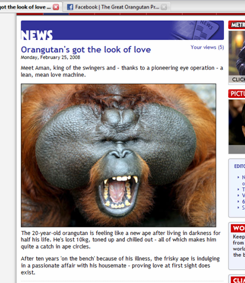 "Meet Aman, king of the swingers and – thanks to a pioneering eye operation – a lean, mean love machine. The 20-year-old orangutan is feeling like a new ape after living in darkness for half his life. He's lost 10kg, toned up and chilled out – all of which makes him quite a catch in ape circles....." Read the full story on the Metro Online: Orangutan's got the look of Love Or click here to find out more about AmanLabels: Borneo, great orangutan project, Malaysia, orang-utan, orangutan volunteer |
posted by Clare @ 8:48 PM
1 comments
|
| Labels: Borneo, great orangutan project, Malaysia, orang utan, Orangutans and Rehabilitation, volunteer |
posted by Clare @ 7:27 PM
1 comments
|
| The most exciting thing to happen this month…. …..
What will follow is hopefully weeks rather than months of getting her to acclimatize to what for her is an alien environment and grow in confidence; untill Hillary and Jugah can teach her what she needs to know. I only found out as we sat on the platform that even as an infant the keepers were never able to get I see Personally I was so lucky to have been a part of that first day, we wanted Jugah to take her up as he is to be her mentor, but when they tried the day before and a few times that morning the centre was too busy with visitors or Doris was just too shy to come out. It was chance that kept me delayed at a meeting all morning and luck in later passing a man on the road selling (expensive) durian. Chance and luck together brought me Alvin and Eddie to that platform to try one last time for the day at a time Tempting Doris out of her Enclosure At the feeding platform Ting San plays whilst Doris is busy eating Doris eating a durian Doris decides to go back to the centre If you cant see the videos click here Thank you to all our past volunteers, without who this amazing progress would not have been possible. Leo Labels: great orangutan project, orang utan, orangutan diary |
posted by Clare @ 9:30 PM
1 comments
|
 New Years Day 2008 Before I can talk about what’s new I have to extend our thanks to everyone who made getting this far possible. The November group of volunteers was Keith & Caroline’s last; I think that every volunteer and visitor that met them will know what an asset they were in assisting the centre to raise animal husbandry standards. They were also the custodians of the project on the ground for us and the face of WOX to our volunteers. In all things the effort and hours they contributed cannot be understated; without them successfully completing the infrastructural phase of the project we would not be able to begin our part in the rehabilitation of animals at MWC. Mostly though a tremendous thank you to each and every one of our past volunteers!
We unsuccessfully tried this with our older females; but will need to be a little more inventive as they simply destroyed the ones we made for them. We were both concerned that Mamu is a little underweight given that she is nearly 3 years old. Chiam stopped producing milk shortly after returning to the centre so we have decided to bottle feed milk formula to her and her daughter as Hillary feels this is the easiest way to start her lactating again and even if it fails it will be extra nutrition for Mamu. We’ve also recruited another experienced orangutan rehabilitator out of his recent retirement to fill the hole left by Hillary’s departure from Semenggoh (our sister sanctuary) Our volunteer coordinator
At the moment we are hiding all of the orangutan & bear feeds either in puzzles or distributed around their enclosures & high on the feeding platforms in order to amuse and make them work for their food; particularly Aman.
A provisional & flexible release plan has been agreed for the deer, and most orangutan Chiam, Ganti, Doris & Mamu and volunteer work for the beginning of next year will be focused on making this happen. Guillaume & I attended the Hornbill conference for conservation in I spent four days over Christmas in the deep jungles of Batang Ai (the long term full wild release site for orangutan successfully rehabilitated at Matang) & received a wonderful present from one of the local Iban communities we work with; when they formally agreed with WOX to no longer hunt any animals for food, apart from the wild boar. Mr Jugah (who many volunteers may know as Apai) also retired from the forestry department at the end of this year. Since he hand-reared Chiam, Ganti, Doris & most of the orangutans MWC have previously released; we felt that we needed his experience and animal relationships a little bit longer (At least until we have released & integrated Chiam & Ganti as he’s the only person who can safely handle them right now) One last thank you to almost two years of volunteers; you all brought funding in order for us to be here and provide animals like Aman and Doris with opportunities, you brought your energy to mix cement or lay down boardwalk & brick in tropical heat. Most of all though you brought the animals, the staff & this centre your love and that is what you bring best. Happy New Year Leo and all at Matang Labels: great orangutan project, Malaysia, matang wildlife centre, orang utan, Orangutans and Rehabilitation, sunbears |
posted by Clare @ 12:06 AM
2 comments
|


